We will use two axioms here: that corresponding angles are equal and angles on a straight line add to 180˚.
Suppose there are two lines \(AB\) and \(CD\) which are parallel, and another line \(EF\) cuts through \(AB\) at \(G\) and also through \(CD\) at \(H\).
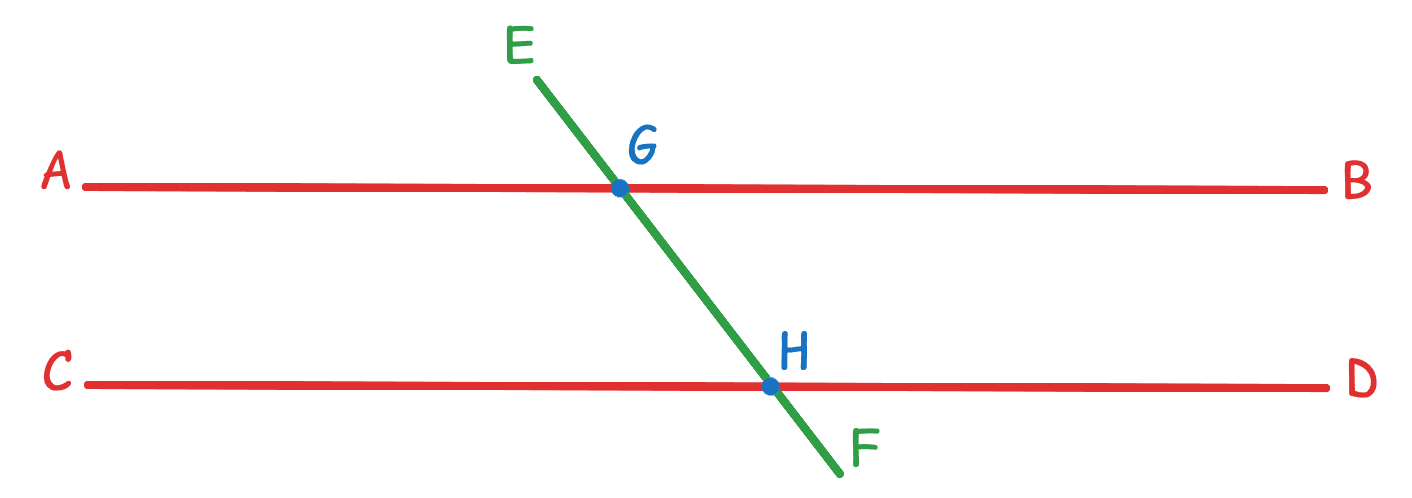
We will start with the axiom that corresponding angles are equal \((\angle EGB = \angle EHD)\). However, since \(\angle AGH\) is vertically opposite \(\angle EGB\), then they are equal. Since \(\angle EGB = \angle EHD\) and \(\angle AGH = \angle EGB\), then \(\angle AGH = \angle EHD\), which proves that alternate angles are equal.
Since angles on a straight line add to 180˚, which means \(\angle EGB + \angle HGB = 180˚\). Since \(\angle EGB = \angle EHD\), then \(\angle EHD + \angle HGB = 180˚\). This shows that consecutive interior angles add to 180˚.