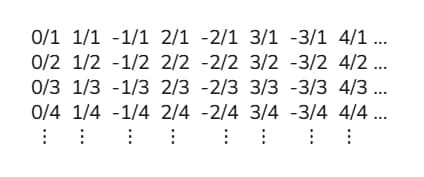
Arrange the rational numbers in a two dimensional array. The \(n\)th row contains the rational number with \(n\) in the denominators. In each the numerators are in the sequence \(0,1,-1,2,-2,3,-3,4,-4,\ldots\). The array is shown here:
Next, we list all fractions on successive diagonals, following the order shown here:
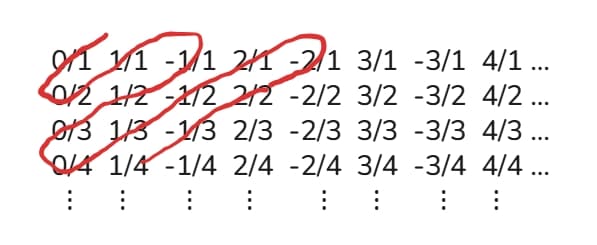
Following the line, the fractions would be listed as so: \(\frac{0}{1}, \frac{0}{2}, \frac{1}{1}, \frac{-1}{1}, \frac{1}{2}, \ldots\). Then, we can remove all the repeated numbers in this list to get \(\frac{0}{1}, \frac{1}{1}, \frac{-1}{1}, \frac{1}{2}, \frac{1}{3}, \frac{-1}{2}, \ldots\). Since this list is one-dimensional, we can associated each number with its position. This gives us a one-to-one coresspondence of each rational number with a natural integer, proving that a set of rational numbers is countable.